
Engine stud elongation: how to know your tierod condition
We still come across situations where shipowners and OEM-engine manufacturers have long discussions on consecutive failures of tierods (studbolts) of mainly cylinder heads. The owner claims he and his engineers have done everything by the book, but the OEM is not following up on (warranty) claims. What can you do to have all the information to state your case?
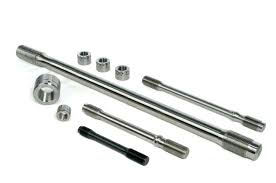
Especially with higly loaded modern medium speed engines, the material of the studbolts it utilized to its maximum mechanical properties. The elongation of the studs, which is generated to clamp down the cylinderheads is a constant force on the stud, but the pressures in the cylinder create huge additional forces, contributing to the fatigue of the studs. A couple of key elements in handling your studbolts:
-always follow the procedures for mounting new studbolts; use the correct oil, grease, sealing rings and torque.
-do yourself a favour, and measure the initial length of the stud. Verify this length, as it is often given in the OEM-manual. If not, contact a service station. This information may be vital if incidents occur.
-ensure no water traps can be formed on top of the O-ring, sealing the thread in the engine block. Some manufacturers do not use O-rings, but will fill up the cavity between engine block and tightened stud with silicone; ideal to prevent water from entering as you can smoothen the silicone yourself.
-During the hydraulic tightening of the studs, follow the correct steps. Do not increase pressure any more then given in the manual. Preferably measure the elongation of the studs, and compare. Deviation and elongation is often given in the OEM manual, but if not ask a local service station. Measuring can best be done with a dial gauge and magnetic stand (yes, you need 4 of them for a 4-stud cylinder head), but the old fashion way
-When dismantling a cylinder head, measure how far the stud comes back. This can only be done with dial gauges; it will tell you if your studs come back to their original length, or are already permanently elongated. Try to find the reason of the elongation, and verify if the stud is still fit for further use. Check for any visual signs of corrosion or mechanical damage to the stud. Renew if in doubt.
The above does not only apply to cylinderhead studs, but can very well be used for all other hydraulically tightened connections such as main bearings and connecting rods.
If you need any further information on this topic, simply contact us!